
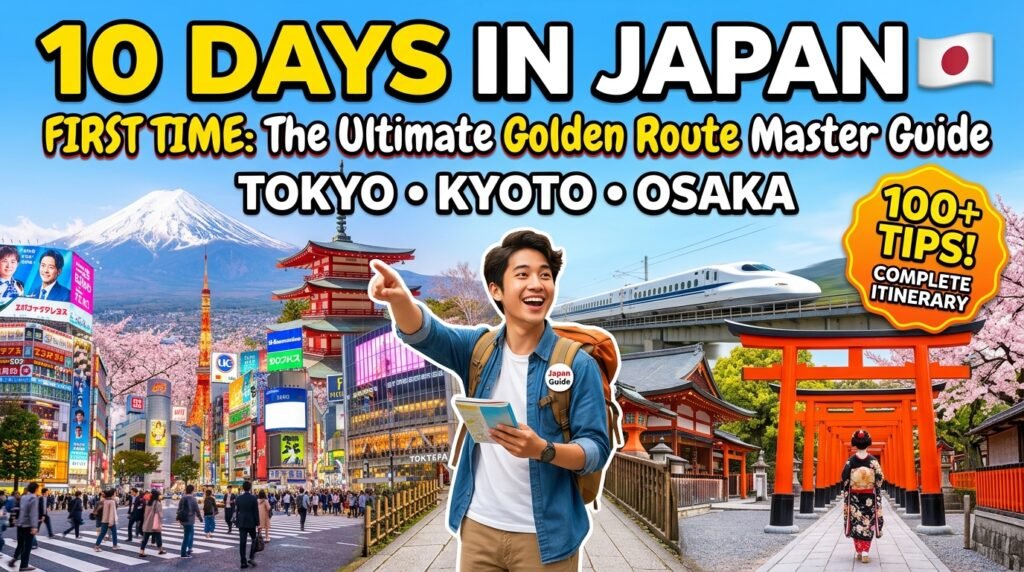
Landing in Tokyo for the very first time can feel like stepping straight into a vibrant blend of futuristic technology and centuries-old tradition. Navigating the sprawling metropolis, hopping onto bullet trains, and exploring hidden mountain shrines might seem overwhelming at first, but with a structured strategy, your inaugural journey will be smooth and unforgettable. Following a well-planned 10 days in japan itinerary first time ensures that you experience the iconic highlights of the “Golden Route”—spanning Tokyo, Kyoto, Nara, and Osaka—without falling victim to burn-out or budget traps.
Key Highlights
- The Perfect Golden Route: Optimally balanced daily schedules covering the ultra-modern streets of Tokyo, the tranquil bamboo groves and temples of Kyoto, the sacred deer of Nara, and the electric street food nightlife of Osaka.
- Comprehensive Financial Blueprint: Detailed budget tier breakdowns covering accommodation, transit, food, and attractions with a complete japan trip cost breakdown usd for budget, mid-range, and luxury travelers.
- Seamless Connectivity & Logistics: Clear guidance on picking the best pocket wifi for japan travel, IC card setup (Suica/Pasmo), high-speed rail navigation, and baggage handling services.
Why 10 days in japan itinerary first time Matters Right Now
Planning a first-time trip to Japan requires an incredible balance of timing, route mapping, and cultural awareness. Ten days is universally recognized by travel experts as the “sweet spot” duration: it is long enough to deeply absorb Japan’s major cultural hubs without causing travel fatigue or requiring weeks of time off from work.
- Optimal Cultural Depth Without Fatigue: A 10-day timeframe provides sufficient room to explore three distinctly unique regions (Kanto, Kansai, and historic day-trip destinations) at a comfortable pace, giving you a full taste of urban, traditional, and culinary atmospheres.
- Maximum Rail Network Efficiency: Utilizing Japan’s world-renowned Shinkansen (bullet train) infrastructure allows you to cover hundreds of miles between Tokyo and Kyoto in under two and a half hours, converting transit hours into active exploration time.
- High Value for Investment: With smart advance planning, clear connectivity setups, and strategic accommodation choices, a 10-day trip yields an exceptionally high return on investment in visual memories, culinary experiences, and stress-free adventure.
Comprehensive Guide to 10 Days in Japan Itinerary First Time
Navigating Japan requires an organized approach split into logical preparation and execution phases. By breaking your travel plan down from pre-departure setup to day-by-day routing, you guarantee a seamless vacation experience.
Phase 1: Getting Started
Setting up your digital and physical logistics before leaving home is essential for a stress-free arrival at Narita, Haneda, or Kansai International Airport.
- Secure Connectivity Early: Never land without active internet. Researching the best pocket wifi for japan travel or purchasing an e-SIM ensures you can instantly load Google Maps and translation apps the moment you clear customs.
- Set Up IC Transit Cards Digitally: Add a digital Suica or Pasmo card directly to your smartphone wallet (Apple Wallet / Google Pay) prior to departure. This lets you tap through train turnstiles, board local buses, and pay at convenience stores without carrying physical coins.
- Organize Passport & Entry Forms: Complete your digital immigration and customs declaration forms via the official Visit Japan Web portal ahead of time to skip long manual queues upon arrival.
- Pack Strategic Footwear: You will easily walk between 15,000 and 25,000 steps per day. Pack supportive, broken-in walking shoes and wear easily removable footwear, as many traditional temples, ryokans, and restaurants require guests to take off their shoes at the door.
Phase 2: Key Execution & Best Practices (The Complete 10-Day Route)
Day 1: Arrival in Tokyo & Neon Nights in Shinjuku
- Morning / Afternoon: Land at Narita (NRT) or Haneda (HND) Airport. Pick up your physical Pocket Wi-Fi router if you rented one, tap your digital IC card onto the airport express train (Narita Express or Tokyo Monorail), and check into your hotel in a central neighborhood like Shinjuku or Shibuya.
- Late Afternoon: Shake off jet lag with a gentle stroll through the tranquil grounds of Shinjuku Gyoen National Garden.
- Evening: Dive headfirst into the neon glow of Shinjuku. Head up to the Tokyo Metropolitan Government Building observation deck for sweeping panorama views of the sprawling city skyline. Finish your night wandering through the narrow, atmospheric alleys of Omoide Yokocho (“Memory Lane”) or Golden Gai for yakitori skewers and draft beer.
Day 2: Modern Culture & Futuristic Tech in Shibuya & Harajuku
- Morning: Begin at the famous Shibuya Crossing—the busiest pedestrian intersection on earth. Take in the view from the SHIBUYA SKY observation deck before visiting the loyal Hachiko Statue.
- Midday: Walk up through Yoyogi Park to reach Meiji Jingu Shrine, a serene Shinto shrine wrapped in a dense forested canopy right in the middle of the city. Afterwards, transition into Takeshita Street in Harajuku to explore youth fashion, pop culture, and colorful street snacks like giant crepes.
- Evening: Stroll down Omotesando Avenue for high-end architecture and boutique shopping, finishing with dinner in the trendy, craft-beer-centric neighborhood of Cat Street.
Day 3: Historic Tokyo in Asakusa & Akihabara Electric Town
- Morning: Travel back in time by visiting Senso-ji, Tokyo’s oldest and most iconic Buddhist temple located in Asakusa. Walk down Nakamise Shopping Street to sample traditional rice crackers (senbei) and sweet red-bean pastries (ningyo-yaki).
- Afternoon: Cruise down the Sumida River via a glass-topped water bus to the Odaiba waterfront, or take the subway over to Akihabara. Immerse yourself in the multi-story retro arcade halls, anime merchandise stores, and electronic shops.
- Evening: Head to Tokyo Skytree or back toward Ginza for a world-class sushi meal or a comforting bowl of rich tonkotsu ramen.
Day 4: Day Trip to Mount Fuji (Hakone or Kawaguchiko)
- Morning: Depart early from Shinjuku Station via the Odakyu Sightseeing Service to Hakone, or take a direct highway bus to Lake Kawaguchiko.
- Afternoon (Hakone Option): Ride the Hakone Tozan Railway, sail across Lake Ashi on a pirate-themed ferry with views of Mount Fuji, and ride the Hakone Ropeway over the active volcanic vents of Owakudani to taste the famous sulfur-boiled black eggs.
- Afternoon (Kawaguchiko Option): Visit the Chureito Pagoda for the iconic postcard view of Mount Fuji framed by a red five-story pagoda. Rent a bicycle to ride along the northern shore of the lake.
- Evening: Unwind in an authentic onsen (hot spring bath) before returning to Tokyo for your final night in the capital.
Day 5: Bullet Train to Kyoto & Traditional Gion Strolls
- Morning: Board the Shinkansen (Tokaido Line) at Tokyo or Shinagawa Station. Rocket westward at 185 mph toward Kyoto, enjoying views of Mount Fuji from the right side of the train (seat E in economy).
- Afternoon: Check into your Kyoto accommodation (consider staying in a traditional ryokan with tatami mat floors). Visit Kennin-ji or Kodai-ji Temple for a calming introduction to Zen garden design.
- Evening: Stroll through the historic lantern-lit cobblestone streets of Gion and Pontocho Alley. Keep your eyes peeled for geiko and maiko moving between evening appointments, and enjoy a traditional kaiseki multi-course dinner.
Day 6: Fushimi Inari Shrines & Arashiyama Bamboo Grove
- Early Morning (6:30 AM): Beat the heavy tourist crowds by arriving at Fushimi Inari Taisha at dawn. Hike through the thousands of vermilion torii gates winding up Mount Inari.
- Midday: Take the train over to Western Kyoto to explore Arashiyama. Walk through the soaring Arashiyama Bamboo Grove, visit Tenryu-ji Temple with its 14th-century landscape garden, and cross the wooden Togetsukyo Bridge.
- Late Afternoon: Climb up to the Iwatayama Monkey Park for panoramic views over Kyoto and interactive encounters with wild Japanese macaques.
- Evening: Enjoy a relaxing dinner featuring Kyoto specialties like fresh yudofu (boiled tofu pot) or matcha-infused desserts.
Day 7: Kinkaku-ji (Gold Pavilion) & Higashiyama Temples
- Morning: Visit Kinkaku-ji (The Golden Pavilion), whose top two floors are completely covered in gold leaf, reflecting brilliantly over the surrounding mirror pond.
- Midday: Explore Ryoan-ji Temple, home to Japan’s most famous Zen dry-landscape rock garden. Afterwards, head over to Eastern Kyoto to walk along the historic stone paths of Ninenzaka and Sannenzaka.
- Late Afternoon: End your temple circuit at Kiyomizu-dera, marveling at its massive wooden stage built without a single nail, offering spectacular vistas across the city.
- Evening: Explore Nishiki Market (“Kyoto’s Kitchen”), sampling fresh seafood skewers, pickled vegetables, soy milk donuts, and local green teas.
Day 8: Day Trip to Nara’s Sacred Deer & Historic Todai-ji
- Morning: Take the Kintetsu or JR line train south from Kyoto to Nara (roughly 45 minutes). Walk through Nara Park, where hundreds of free-roaming, bow-trained sika deer freely interact with visitors.
- Midday: Enter Todai-ji Temple, one of the world’s largest wooden buildings, housing the Great Buddha (Daibutsu)—a majestic 15-meter bronze statue. Continue walking up the stone path to Kasuga Taisha Shrine, famous for its thousands of stone and bronze lanterns.
- Late Afternoon: Transfer onward by train to Osaka, checking into your hotel in the bustling Namba or Umeda districts.
- Evening: Immerse yourself in the kinetic energy of Dotonbori. Take photos with the famous neon Glico Running Man sign and indulge in street food classics like piping-hot takoyaki (octopus balls) and okonomiyaki (savory cabbage pancakes).
Day 9: Osaka Castle, Shinsekai & Modern Scenery
- Morning: Visit Osaka Castle (Osakajo), exploring the museum inside and strolling through the expansive park grounds and historic stone moats.
- Afternoon: Head over to the retro district of Shinsekai, built in 1912 with design inspirations from Paris and New York. Sample kushikatsu (deep-fried skewered meats and vegetables) at a traditional counter.
- Late Afternoon: Experience modern architectural design at the Umeda Sky Building, taking the floating glass escalator up to the Kuchu Teien Observatory for sunset over Osaka Bay.
- Evening: Spend your final night shopping in the subterranean arcades of Shinsaibashi or enjoying craft cocktails in the atmospheric bars of Amerikamura.
Day 10: Souvenir Shopping & Departure
- Morning: Enjoy a relaxed breakfast at a traditional Japanese cafe (kissaten) for a classic “morning service” toast and coffee. Pick up last-minute souvenirs like KitKats in regional flavors, matcha powder, ceramics, and stationary.
- Afternoon: Take the Haruka Express train directly from Osaka/Shin-Osaka Station to Kansai International Airport (KIX), or take the Shinkansen back to Tokyo for your flight out of Narita or Haneda Airport.
Phase 3: Financial Planning & Connectivity Breakdown
A successful execution of your 10 days in japan itinerary first time relies heavily on managing your financial budget in US Dollars (USD) and maintaining continuous high-speed data connectivity across urban centers and rural train transit.
Understanding the Japan Trip Cost Breakdown USD
Understanding exact trip costs prevents financial surprises. Japan offers incredible value across every budget level, especially with favorable exchange rates. Below is a comprehensive estimated japan trip cost breakdown usd for a 10-day trip per person (excluding international long-haul flights):
| Expense Category | Budget Traveler (USD) | Mid-Range Traveler (USD) | Luxury Traveler (USD) |
| Accommodation (9 Nights) | $450 – $720 ($50–$80/night in hostels/capsules) | $1,170 – $1,980 ($130–$220/night in 3–4 star hotels) | $3,600 – $7,200+ ($400–$800+/night in luxury/ryokans) |
| Intercity & Local Transit | $180 – $250 (Regional passes & individual tickets) | $250 – $350 (Shinkansen reserved seats + IC Card) | $500 – $900 (Green Car Shinkansen + private taxis) |
| Food & Dining | $250 – $400 ($25–$40/day: konbini & ramen) | $500 – $800 ($50–$80/day: izakayas & mid-range) | $1,500 – $3,000+ ($150–$300+/day: fine dining/kaiseki) |
| Attractions & Sightseeing | $60 – $120 (Free temples + select paid decks) | $150 – $250 (TeamLab, SHIBUYA SKY, key temples) | $400 – $800 (Private guided tours & VIP entries) |
| Connectivity & Data | $15 – $25 (Basic e-SIM pack) | $30 – $50 (Unlimited e-SIM or Pocket Wi-Fi) | $60 – $100 (Premium multi-device Pocket Wi-Fi) |
| Estimated Total (Excl. Flights) | $955 – $1,565 USD | $2,100 – $3,430 USD | $6,060 – $12,000+ USD |
Connectivity Matrix: Finding the Best Pocket Wifi for Japan Travel
Staying connected is non-negotiable for real-time train navigation via Google Maps, translating menus, and checking attraction wait times. Travelers generally choose between renting a portable Wi-Fi router (Pocket Wi-Fi) or activating a digital e-SIM. When evaluating options for the best pocket wifi for japan travel, consider data caps, battery endurance, and pickup convenience:
- Pocket Wi-Fi Rentals (Ideal for Groups & Families): Pocket Wi-Fi devices create a local personal Wi-Fi network that allows multiple devices (smartphones, laptops, tablets) to connect simultaneously. Leading providers like Japan Wireless, NINJA WiFi, and Sakura Mobile offer unlimited high-speed 4G/5G data packages. Units can be picked up directly at major airport arrival counters (Narita, Haneda, Kansai) or delivered straight to your first hotel. Returning the device is simple: drop it into any Japanese postal box before departing using the provided prepaid return envelope.
- e-SIM Digital Data Plans (Ideal for Solo Travelers & Couples): If your smartphone is unlocked and supports e-SIM functionality, this is often the most convenient and cost-effective option. Digital e-SIM providers (such as Airalo, Ubigi, or Holafly) allow you to download a data profile via a QR code prior to landing. Upon arrival in Japan, your phone connects directly to major Japanese mobile networks like NTT Docomo or SoftBank without needing physical hardware, charging extra battery packs, or mailing anything back.
Strategic Comparison & Quick Overview
| Travel Style Option | Key Highlights | Optimal Conditions | Ideal For |
| The Classic Golden Route (Tokyo-Kyoto-Osaka) | Perfect mix of urban tech, historic temples, night markets, and high-speed rail. | 10 to 12 days total duration; year-round travel. | First-time visitors wanting iconic highlights. |
| The Nature & Alps Extension (Tokyo-Takayama-Kanazawa) | Historic wooden villages, traditional crafts, preserved samurai districts, and mountain scenery. | Spring through late Autumn; travelers who prefer lower crowd density. | Repeat visitors or nature and history enthusiasts. |
| The Southern Cultural Loop (Osaka-Hiroshima-Miyajima) | Deep historical significance, floating torii gates, world-class culinary scene, peace memorials. | Easily added via a 2-3 day extension from Kansai. | Travelers interested in WWII history and island scenery. |
Essential Rules to Keep in Mind
- Respect Trash & Smoking Regulations: Public trash cans are extremely rare across Japanese cities; always carry a small plastic bag in your daypack to hold your trash until returning to your hotel room or convenience store. Public smoking while walking is strictly illegal in most cities; smoke only in designated indoor/outdoor glass enclosures.
- Master Onsen & Sento Etiquette: Always wash and rinse your body completely at the shower stations before stepping into communal thermal bath waters. Swimsuits are strictly prohibited in traditional public hot springs; enter completely naked, and keep your small privacy towel out of the bath water.
- Understand Cash vs. Digital Payments: While Japan has rapidly adopted digital IC card payments, credit cards, and mobile pay, small rural ramen shops, temple entrance booths, and coin-operated lockers still require physical Japanese Yen (JPY) cash. Always keep ¥10,000 to ¥20,000 cash in your wallet.
- Practice Quiet Public Transit Etiquette: Train cars are kept exceptionally quiet. Set your phone to silent mode (“Manner Mode”), avoid making phone calls, keep voice volumes low when speaking to companions, and eat or drink only on long-distance Shinkansen trains—never on local subways.
Resources & Recommended Reading
- Official Portals: Consult the Japan National Tourism Organization (JNTO) official site and the Visit Japan Web portal for current entry requirements, emergency alerts, and transit advisories.
- Expert Guides: Explore detailed travel planning resources, rail route calculators, and packing guides across reputable international travel portals and regional tourism boards.
Frequently Asked Questions
- Is 10 days really enough time for a first trip to Japan?Yes, 10 days is the ideal timeframe for a first-time visitor. It allows you to explore Tokyo, Kyoto, Nara, and Osaka thoroughly without feeling overly rushed, covering the most iconic historical and modern landmarks.
- How much should I budget for a 10 days in japan itinerary first time in USD?A realistic japan trip cost breakdown usd ranges from $1,000–$1,500 USD for budget travelers, $2,000–$3,500 USD for mid-range comfort, and $6,000+ USD for luxury accommodations and fine dining (excluding international flights).
- Should I rent a Pocket Wi-Fi or buy an e-SIM for internet access?Evaluating the best pocket wifi for japan travel depends on your group size. Pocket Wi-Fi is superior for families or groups sharing a connection across multiple devices, while e-SIMs offer cheap, hardware-free data for solo travelers or couples.
- Is the nationwide 7-Day Japan Rail (JR) Pass still worth buying?Since the significant price increase in late 2023, the nationwide JR Pass is rarely cost-effective for a simple Tokyo-Kyoto-Osaka round trip. Buying individual point-to-point Shinkansen tickets or regional passes is usually much cheaper.
- When is the best time of year to take a 10-day trip to Japan?Spring (late March to early April) for cherry blossoms and Autumn (October to November) for vibrant fall foliage and comfortable walking weather are widely considered the absolute best seasons to visit.
- Do I need to speak Japanese to navigate Japan comfortably?No, English signage is widespread across major train stations, airports, and tourist areas. Using translation apps like Google Translate alongside digital navigation tools makes communication effortless.
- How do I handle luggage on the Shinkansen bullet trains?Standard overhead racks accommodate small to medium suitcases easily. For oversized luggage (where total dimensions exceed 160 cm), you must reserve a specific rear-row seat in advance or use luggage forwarding services (Takuhaibin) to ship bags overnight between hotels.
- Can I use my credit card everywhere in Japan?Credit cards are accepted at most hotels, major department stores, and chain restaurants. However, small local eateries, temple gates, market stalls, and bus routes often require physical cash or IC card payments.
- What is an IC Card and how do I get one?An IC Card (such as Suica or Pasmo in Kanto, or ICOCA in Kansai) is a rechargeable contactless smart card used for public transit and store purchases. You can instantly add a digital Suica or Pasmo directly to your iPhone Wallet app before flying.
- What are the top street foods I must try in Osaka?Do not leave Osaka without trying takoyaki (grilled octopus balls topped with savory sauce and bonito flakes), okonomiyaki (savory cabbage pancakes), and kushikatsu (crispy deep-fried skewered meats and vegetables).
Final Thoughts
Embarking on a 10 days in japan itinerary first time is an extraordinary adventure that balances ancient traditions with incredible modern innovation. By setting up your logistics early—securing your connectivity, estimating your budget in USD, and following a structured route—you will experience the absolute best that Japan has to offer without unnecessary stress. Prepare your walking shoes, charge your camera, and get ready for an unforgettable journey through the heart of Japan!