
Crossing Japan onboard the legendary Shinkansen—the high-speed bullet train system renowned for pinpoint punctuality, ultra-smooth rides, and speeds exceeding 300 kilometers per hour—is a quintessential bucket-list experience.
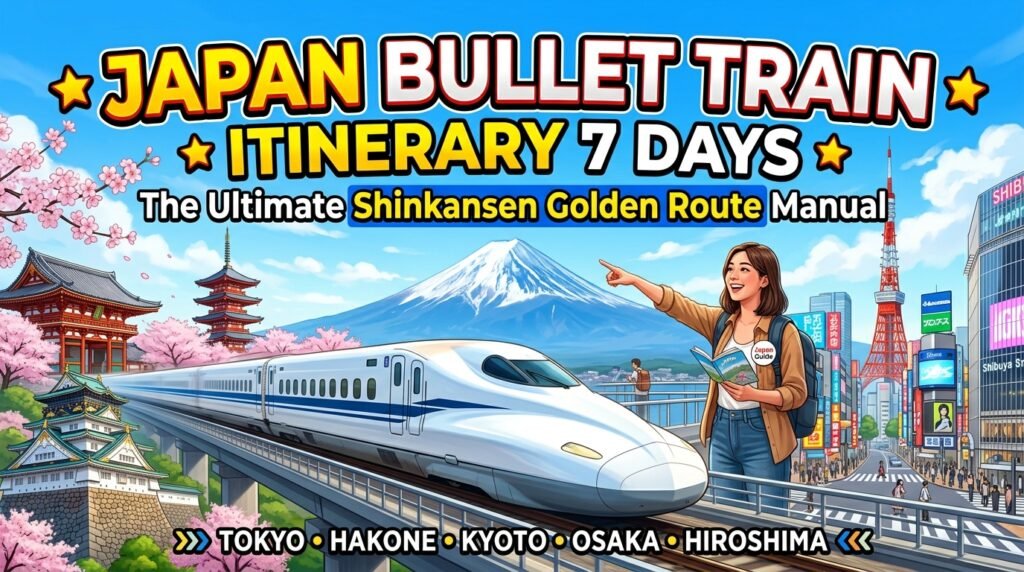
Executing a japan bullet train itinerary 7 days allows travelers to seamlessly bridge the gap between neon-lit modern megacities, ancient temple precincts, majestic alpine landscapes, and world-class culinary capitals. Because Japan’s transit infrastructure is so densely interconnected, a single week provides more than enough time to experience the country’s iconic “Golden Route”—stretching from Tokyo down through Mount Fuji’s foothills to Kyoto, Osaka, and Hiroshima.
Designing a high-speed railway adventure requires balancing transit logistics with immersive sightseeing. From deciding whether to purchase individual point-to-point digital tickets versus regional or nationwide Japan Rail (JR) passes, to navigating strict Tokaido Shinkansen luggage size restrictions, proper preparation makes all the difference. This 4,000-word master guide breaks down every single day of your 7-day bullet train journey, complete with station navigation steps, timing schedules, neighborhood guides, food recommendations, seat selection hacks, and rail cost analyses.
Key Highlights
- The Iconic Golden Route Corridor: Traverse Tokyo, Hakone (Mount Fuji), Kyoto, Osaka, and Hiroshima effortlessly via the Tokaido and Sanyo Shinkansen lines.
- Mastering High-Speed Rail Logistics: Learn how to book reserved seats, secure dedicated oversized baggage spaces, and navigate bullet train stations like a seasoned local.
- Comprehensive Cost Breakdown: Evaluate whether a nationwide 7-Day JR Pass or individual point-to-point Shinkansen digital tickets suit your travel budget best.
Why japan bullet train itinerary 7 days Matters Right Now
Planning a 7-day trip around Japan’s bullet train network provides an unmatched mix of speed, flexibility, and comfort. Rather than wasting hours dealing with airport security check-ins, baggage drops, and remote airport tarmac transfers, the Shinkansen deposits passengers directly into the vibrant hearts of major city centers.
- Maximizing Limited Travel Time: High-speed rail shrinks a 500-kilometer overland journey from Tokyo to Kyoto down to a comfortable 2 hours and 15 minutes. This allows you to spend your time exploring ancient wooden temples rather than sitting on a highway bus or waiting at airport departure gates.
- Stress-Free City-Center Connections: Japan’s major bullet train hubs—including Tokyo Station, Shin-Osaka, and Kyoto Station—integrate seamlessly with city subway grids, local private railways, and taxi ranks.
- Exceptional Comfort & Culinary Experiences: Spacious legroom, whisper-quiet carriages, rotating plush seats, personal power outlets, and the iconic culture of station ekiben (curated bento boxes) make every leg of the journey an enjoyable event in itself.
Comprehensive Guide to japan bullet train itinerary 7 days
Navigating a fast-paced 7-day trip across Honshu requires a well-structured approach. The following step-by-step master walkthrough takes you through pre-trip preparation, daily routing, and advanced logistical optimizations.
Phase 1: Getting Started
Before stepping onto a bullet train platform, you must establish your ticketing strategy, understand luggage regulations, and gather essential digital navigation tools.
1. Ticketing Strategy: JR Pass vs. Point-to-Point Tickets
One of the most crucial decisions for any japan bullet train itinerary 7 days is choosing how to purchase your rail tickets.
- Individual Digital Tickets: Following adjustments to nationwide Japan Rail Pass pricing, buying individual point-to-point Shinkansen tickets via official platforms (such as SmartEX for the Tokaido/Sanyo lines or JR-WEST/JR-EAST official portals) is frequently the most cost-effective option for a standard 7-day Golden Route itinerary. Point-to-point tickets allow you to ride the fastest express services—such as the Nozomi and Mizuho—without paying any mandatory supplemental fees.
- Nationwide 7-Day Japan Rail Pass: If you plan to add rapid long-distance detours (such as extending all the way to Hiroshima, Hakata in Kyushu, or Kanazawa in the Japanese Alps) within a tight 7-day window, the nationwide pass remains a convenient option. Keep in mind that riding Nozomi or Mizuho trains on a JR Pass requires purchasing a dedicated supplemental ticket per section; otherwise, pass holders ride the slightly slower Hikari or Sakura trains, which add only about 20 to 30 minutes to total travel time.
- Regional JR Passes: Depending on your route, regional passes (such as the JR Kansai-Hiroshima Area Pass or JR Kansai-Hokuriku Area Pass) offer exceptional savings if you focus your travels within specific provinces.
2. Shinkansen Luggage Rules (The 160 cm Rule)
Japan Railways enforces strict baggage policies across the Tokaido, Sanyo, Kyushu, and Nishi-Kyushu Shinkansen lines.
┌─────────────────────────────────────────────────────────────────┐
│                 SHINKANSEN LUGGAGE SIZE TIERS                   │
├───────────────────┬──────────────────────┬──────────────────────┤
│ TOTAL DIMENSIONS  │ SIZE CATEGORY        │ REQUIREMENT          │
│ (L + W + H)       │                      │                      │
├───────────────────┼──────────────────────┼──────────────────────┤
│ Under 160 cm      │ Small / Medium / Cabin│ No reservation needed│
│ (Under 63 in)     │                      │ Fits in overhead rack│
├───────────────────┼──────────────────────┼──────────────────────┤
│ 160 cm to 250 cm  │ Large / Oversized    │ FREE Reservation     │
│ (63 in to 98 in)  │                      │ Required in Advance  │
├───────────────────┼──────────────────────┼──────────────────────┤
│ Over 250 cm       │ Prohibited Onboard   │ Must use Takkyubin   │
│ (Over 98 in)      │                      │ Luggage Forwarding   │
└───────────────────┴──────────────────────┴──────────────────────┘
- Standard Luggage (Under 160 cm total dimensions): Cabin bags, small backpacks, and medium check-in suitcases easily fit on the spacious overhead luggage racks above your seat. No advance seat reservation or extra fee is needed.
- Oversized Luggage (160 cm to 250 cm total dimensions): If your suitcase’s combined length, width, and height add up to between 160 cm and 250 cm, you must book a specific seat with an “Oversized Baggage Area” (located behind the last row of seats) or an “Oversized Baggage Compartment”. This reservation is completely free when made prior to boarding. Boarding without this reservation incurs a 1,000 JPY onboard penalty fee per bag, and train staff will relocate your bag to a designated holding zone.
- Luggage Forwarding (Takkyubin): To travel completely hands-free, use door-to-door luggage forwarding services like Yamato Transport (Kuroneko Yamato). You can ship large suitcases directly from your hotel front desk in Tokyo to your hotel in Kyoto or Osaka for roughly 2,000 to 3,000 JPY per bag, arriving the next morning.
3. Essential Navigation Apps & Connectivity
- Digital IC Cards: Add a digital Suica or Pasmo card to your smartphone’s wallet app before landing. These contact-less cards are essential for paying fares on city subways, local JR commuter lines, city buses, and for making purchases at vending machines and convenience stores (konbini).
- Transit Search Engines: Download navigation tools like Japan Travel by NAVITIME, Google Maps, or Jorudan to access real-time platform numbers, carriage location suggestions, and detailed transfer steps across major rail hubs.
- eSIM / Pocket Wi-Fi: Maintain high-speed data connectivity throughout your journey to monitor real-time train updates and access digital tickets on the go.
Phase 2: Day-by-Day Master Itinerary Execution
The following detailed daily itinerary forms the classic 7-day Golden Route across Japan. It optimizes transit legs while ensuring you experience iconic landmarks, regional delicacies, and rich cultural traditions.
┌─────────────────────────────────────────────────────────────────┐
│               7-DAY BULLET TRAIN ROUTE OVERVIEW                 │
├───────┬──────────────────────┬──────────────────────────────────┤
│ DAY   │ LOCATION             │ KEY HIGHLIGHTS                   │
├───────┼──────────────────────┼──────────────────────────────────┤
│ Day 1 │ Tokyo Arrival        │ Asakusa, Skytree, Shibuya Crossing│
│ Day 2 │ Tokyo Exploration    │ Meiji Shrine, Harajuku, Akihabara│
│ Day 3 │ Mt. Fuji & Hakone    │ Odakyu Romancecar, Onsen, Views  │
│ Day 4 │ Kyoto Transfer       │ Tokaido Shinkansen, Fushimi Inari│
│ Day 5 │ Kyoto Historic Core  │ Arashiyama, Kinkaku-ji, Gion     │
│ Day 6 │ Hiroshima & Miyajima │ Sanyo Shinkansen, Peace Park, Osaka│
│ Day 7 │ Osaka & Return       │ Dotonbori, Bullet Train to Tokyo │
└───────┴──────────────────────┴──────────────────────────────────┘
Day 1: Welcome to Tokyo — Modern Metropolis & Ancient Roots
Arrive at either Narita International Airport (NRT) or Haneda Airport (HND). Take the dedicated airport express rail lines—the Narita Express (N’EX) or Skyliner from Narita, or the Tokyo Monorail/Keikyu Line from Haneda—directly into central Tokyo.
- Morning / Afternoon Check-In: Base yourself in a centrally connected neighborhood near a major station along the Yamanote Loop Line, such as Shinjuku, Tokyo Station, or Shinagawa.
- Asakusa & Senso-ji Temple: Begin your exploration in Tokyo’s oldest geisha and temple district. Walk through the iconic Kaminarimon (Thunder Gate), marveling at its massive red paper lantern, and stroll down Nakamise-dori shopping street to sample fresh ningyo-yaki (small sponge cakes filled with sweet red bean paste) and senbei (crispy rice crackers).
- Tokyo Skytree: Walk 15 minutes across the Sumida River to the base of Tokyo Skytree. Ascend to the Tembo Deck (350 meters) or Tembo Galleria (450 meters) for panoramic sunset views stretching across the endless Tokyo urban sprawl toward Mount Fuji on clear days.
- Evening in Shibuya: Take the Tokyo Metro Ginza Line directly to Shibuya Station. Experience the famous Shibuya Crossing—the busiest pedestrian intersection in the world. Grab dinner at a local izakaya (Japanese pub) or sample steaming bowls of rich tonkotsu ramen in the surrounding lanes of Center-Gai.
Day 2: Tokyo — Pop Culture, Imperial Gardens & High-Tech Districts
Spend your second full day diving deeper into Tokyo’s contrasting modern subcultures and serene green sanctuaries.
- Morning Peace at Meiji Jingu Shrine: Start your day at 8:00 AM walking through the majestic wooden torii gates of Meiji Shrine, surrounded by a dense forest of over 120,000 trees in the heart of the city.
- Harajuku & Takeshita Street: Exit the shrine grounds directly into Harajuku. Walk down Takeshita Street to explore vibrant street fashion, colorful boutique shops, and famous multi-layered sweet crepes.
- Imperial Palace East Gardens: Head toward Tokyo Station to explore the Imperial Palace East Gardens. Stroll past historic stone moats, guardhouses, and the foundations of the ancient Edo Castle keep.
- Akihabara Electric Town: Take the Yamanote Line north to Akihabara. Immerse yourself in multi-story electronics department stores (like Yodobashi Camera), retro video game shops (Super Potato), anime merchandise centers, and theme cafes.
- Dinner & Drinks in Omoide Yokocho: Return to Shinjuku for dinner in Omoide Yokocho (“Memory Lane”), a atmospheric maze of narrow alleyways lined with tiny counter-service stalls grilling savory yakitori skewers over glowing binchotan charcoal.
Day 3: Tokyo to Hakone — Mount Fuji Views & Hot Springs
Leave the capital behind and travel west toward the Hakone geothermal region, famous for scenic views of Mount Fuji, mountain funiculars, and traditional hot spring resorts (ryokan).
- Morning Departure via Odakyu Romancecar: From Shinjuku Station, board the comfortable Limited Express Romancecar to Hakone-Yumoto Station (approx. 85 minutes). Alternatively, take the Tokaido Shinkansen from Tokyo Station to Odawara Station (approx. 35 minutes) and transfer to the local Hakone Tozan Railway.
- The Hakone Loop Adventure: Purchase a Hakone Free Pass at Odawara or Hakone-Yumoto Station for unlimited access to the region’s transport network:
- Hakone Tozan Railway: Ride the historic mountain switchback train up steep forested valleys to Gora.
- Hakone Tozan Cable Car & Ropeway: Ascend past mountain peaks to Owakudani (“Great Boiling Valley”), a dramatic active volcanic crater. Sample famous kuro-tamago (black eggs boiled in sulfurous hot springs, local legend says eating one adds seven years to your life!).
- Lake Ashi Pirate Ship Cruise: Board a decorative vessel to sail across Lake Ashi, taking in views of Mount Fuji framed by the bright red watergate torii of Hakone Shrine.
- Overnight in a Traditional Ryokan: Check into a local ryokan. Unwind in therapeutic thermal mineral waters (onsen), and savor an elaborate multi-course kaiseki dinner featuring fresh seasonal ingredients.
Day 4: Tokaido Shinkansen to Kyoto — Ancient Imperial Capital
After a relaxing morning soak, return to Odawara Station to catch your first major bullet train journey on the Tokaido Shinkansen line down to Kyoto.
┌─────────────────────────────────────────────────────────────────┐
│               TOKAIDO SHINKANSEN ROUTE DETAILS                  │
├───────────────────┬─────────────────────────────────────────────┤
│ ROUTE SECTION     │ Odawara Station to Kyoto Station            │
│ DISTANCE          │ Approx. 460 kilometers (285 miles)          │
│ DURATION          │ Approx. 2 hours via Hikari Shinkansen       │
│ SEAT SELECTION    │ Seat E (Standard) / Seat D (Green Car)     │
│ PRO TIP           │ Offers best views of Mount Fuji on right    │
└───────────────────┴─────────────────────────────────────────────┘
- The Bullet Train Experience: Board the Hikari or Nozomi Shinkansen bound for Kyoto. Pick up an ekiben (station bento box) and local green tea at Odawara Station before boarding.
- Mount Fuji Viewing Hack: When heading west toward Kyoto, reserve Seat E in Standard Class (or Seat D in 2×2 Green Car seating). This places you on the right side of the train, offering sweeping views of Mount Fuji as the bullet train zooms past Shin-Fuji Station roughly 40 minutes into the journey.
- Afternoon Arrival in Kyoto: Step off at the futuristic Kyoto Station. Check into your hotel and take the local JR Nara Line just two stops to Inari Station.
- Fushimi Inari Taisha at Dusk: Walk through the mesmerizing corridors of over 10,000 vibrant vermilion torii gates winding up the sacred Mount Inari. Visiting in the late afternoon or early evening offers lower crowd levels and magical photo lighting as lanterns light up along the path.
- Evening Walk in Pontocho Alley: Head to central Kyoto for dinner along Pontocho Alley, a narrow pedestrian lane running parallel to the Kamogawa River. Keep an eye out for geiko or maiko walking to evening appointments in nearby Gion.
Day 5: Kyoto — Bamboo Groves, Golden Pavilions & Gion Culture
Spend a full day exploring Kyoto’s magnificent UNESCO World Heritage sights.
- Early Morning in Arashiyama (7:30 AM): Beat the crowds by taking the JR San-in/Sagano Line from Kyoto Station to Saga-Arashiyama Station. Walk through the towering Arashiyama Bamboo Grove as morning light filters through the green stalks.
- Tenryu-ji Temple & Okochi Sanso Villa: Visit Tenryu-ji Temple to admire its 14th-century landscape garden, framed by the surrounding Arashiyama mountains. Afterwards, step into the peaceful grounds of Okochi Sanso Villa to enjoy matcha tea and fresh sweet treats overlooking the valley.
- Kinkaku-ji (The Golden Pavilion): Take a short taxi ride or city bus north to Kinkaku-ji. Marvel at the top two floors covered entirely in gold leaf, perfectly reflected across the surrounding Mirror Pond.
- Higashiyama Historic Streets: Cross town to the Eastern Hills. Walk down the preserved stone-paved pedestrian slopes of Sannenzaka and Ninenzaka, lined with traditional wooden shopfronts selling pottery, green tea sweets, and handcrafted souvenirs.
- Kiyomizu-dera Temple: Conclude your afternoon on the expansive wooden veranda of Kiyomizu-dera Temple, built entirely without nails. Enjoy panoramic views over Kyoto’s skyline framed by seasonal cherry blossoms or vibrant autumn maple leaves.
Day 6: Hiroshima & Miyajima Island Day Trip — Sanyo Shinkansen
Board the Sanyo Shinkansen line bound for Hiroshima, experiencing a poignant history lesson alongside one of Japan’s most picturesque coastal islands.
- Morning Shinkansen to Hiroshima: Take the Sakura, Hikari, or Nozomi Shinkansen from Kyoto or Shin-Osaka Station to Hiroshima Station (approx. 1 hour and 40 minutes).
- Miyajima Island (Itsukushima): Upon reaching Hiroshima Station, take the local JR Sanyo Line to Miyajimaguchi Station, then board the JR Miyajima Ferry (covered by the nationwide JR Pass, with a small local island tax).
- Itsukushima Shrine: Admire the famous “floating” red torii gate standing in the tidal waters of the Seto Inland Sea.
- Mt. Misen Ropeway: Ride the ropeway up Mount Misen for breathtaking views across the island-dotted Seto Inland Sea national park.
- Street Food Delights: Try local specialties along Omotesando Shopping Street, including grilled Hiroshima oysters, maple-leaf-shaped momiji manju cakes, and local craft beers.
- Hiroshima Peace Memorial Park & Museum: Return to central Hiroshima via tram or train. Walk through the Peace Memorial Park, pause at the atomic-bomb-survived Genbaku Dome (A-Bomb Dome), and explore the deeply moving exhibits inside the Hiroshima Peace Memorial Museum.
- Evening Travel to Osaka: Board the evening Sanyo Shinkansen back to Shin-Osaka Station (approx. 85 minutes). Check into your hotel in Osaka’s vibrant Namba or Umeda district.
Day 7: Osaka Gastronomy & Return Shinkansen to Tokyo
Conclude your 7-day high-speed rail adventure in Japan’s kitchen capital before riding the bullet train back to Tokyo for your flight home.
- Morning at Osaka Castle: Explore the iconic multi-tiered keep of Osaka Castle, surrounded by stone moats, grand turrets, and expansive park grounds.
- Shinsekai & Tsutenkaku Tower: Travel south to Shinsekai, a retro district designed in 1912. Sample hot, crispy skewers of kushikatsu (breaded and deep-fried meat and vegetables) at a local counter shop.
- Dotonbori Street Food Feast: Head to Dotonbori, Osaka’s ultimate entertainment hub. Walk past giant animated storefront signs (including the famous Glico Running Man). Enjoy iconic street foods such as piping-hot takoyaki (octopus balls sprinkled with bonito flakes) and okonomiyaki (savory cabbage pancakes cooked on hot iron griddles).
- Return Shinkansen Ride to Tokyo: Head to Shin-Osaka Station. Board the Tokaido Shinkansen back to Tokyo Station (2 hours and 15 minutes on the Nozomi, or 2 hours and 40 minutes on the Hikari).
- Airport Departure: Connect directly from Tokyo Station to Narita Airport via the N’EX, or from Shinagawa Station to Haneda Airport via the Keikyu Line, concluding your 7-day high-speed adventure.
Phase 3: Advanced Optimization & Operational Secrets
To ensure your high-speed rail trip runs with absolute precision, incorporate these expert operational recommendations.
As highlighted by the editorial team at https://blogs666.online/, mastering station navigation and train classes elevates a good trip into an effortless journey.
1. Deciphering Shinkansen Train Categories
On the Tokaido and Sanyo lines, three main categories of bullet trains operate along the same physical tracks:
- Nozomi (Fastest / Express): Stops only at major metropolitan stations (Tokyo, Shinagawa, Shin-Yokohama, Nagoya, Kyoto, Shin-Osaka, Kobe, Hiroshima, Hakata). Runs up to 12 times per hour. Covered by individual tickets; requires a paid supplement ticket if using a nationwide JR Pass.
- Hikari (Semi-Express): Makes a few additional regional stops. Takes roughly 20–30 minutes longer between Tokyo and Osaka compared to the Nozomi. Fully covered by the nationwide JR Pass without extra fees.
- Kodama (Local Bullet Train): Stops at every single Shinkansen station along the line. Excellent for short regional hops (e.g., Tokyo to Odawara/Atami), but slow for long-distance city transfers.
2. Ordinary Car vs. Green Car (First Class)
- Standard / Ordinary Cars: 3×2 seat configuration. Generous legroom (far superior to international airline economy), recliners, tray tables, overhead racks, and power outlets at window seats or under seat rows.
- Green Cars (First Class): 2×2 seat configuration. Wider plush seats, footrests, personal reading lights, extra legroom, quieter carriages, and dedicated seat-side service options.
┌─────────────────────────────────────────────────────────────────┐
│                 SHINKANSEN CAR CLASS COMPARISON                 │
├───────────────────┬──────────────────────┬──────────────────────┤
│ FEATURE           │ ORDINARY CAR         │ GREEN CAR (1ST CLASS)│
├───────────────────┼──────────────────────┼──────────────────────┤
│ Seating Layout    │ 3 x 2 Row Layout     │ 2 x 2 Row Layout     │
│ Legroom & Width   │ Very Generous        │ Extra Deep Recline   │
│ Footrests         │ No                   │ Adjustable Built-In  │
│ Atmosphere        │ Active & Family-Friendly Noise-Controlled   │
│ Average Cost Diff │ Standard Base Rate   │ ~30% to 40% Premium  │
└───────────────────┴──────────────────────┴──────────────────────┘
3. Platform Etiquette & Onboard Amenities
- Queuing Markers: Platforms have precise line markings painted on the floor showing exact carriage numbers and door positions. Line up behind the designated markings before your train arrives.
- Prompt Boarding: Bullet trains stop at intermediate stations for as little as 45 to 60 seconds. Have your bags ready and step onboard as soon as arriving passengers clear the doors.
- Onboard Quiet Rules: Keep mobile phones set to silent (“Manner Mode”). If you need to make or take a voice call, step out into the hallway between carriages. Use headphones when listening to audio or watching videos.
- Trash Disposal: Collect your waste before arrival and dispose of it in the recycling and trash bins located in the train entry vestibules.
Strategic Comparison & Quick Overview
The following quick overview summarizes key transportation options and booking strategies for your 7-day journey across Japan:
| Booking Approach | Key Highlights | Optimal Conditions | Ideal For |
| Individual Digital Tickets (SmartEX) | Direct access to all Nozomi and Mizuho trains; easy digital seat selection on your phone; no pass activation lines. | Standard 7-day Golden Route (Tokyo–Kyoto–Osaka–Hiroshima–Tokyo). | Independent travelers wanting maximum speed and flexible schedules. |
| Nationwide 7-Day JR Pass | Unlimited rides on JR lines, local buses, and Miyajima ferry; single physical pass simplicity. | Multi-city itineraries extending beyond the standard route. | Travelers making multiple long-distance high-speed train journeys within 7 days. |
| Regional JR Passes (e.g., Kansai-Hiroshima) | High cost savings within targeted geographic regions; covers local express lines and regional bullet trains. | Flights arriving in Osaka (KIX) and exploring Western Japan. | Regional explorers concentrating on Kyoto, Osaka, Nara, Kobe, and Hiroshima. |
Essential Rules to Keep in Mind
- Reserve Oversized Luggage Space Early: If traveling with suitcases measuring between 160 cm and 250 cm, lock in reserved seats with oversized baggage space when booking your ticket to avoid the 1,000 JPY fee.
- Avoid Peak Rush Hour Boarding: Try to avoid traveling on local commuter lines and major bullet train legs during morning rush hours (7:30 AM – 9:00 AM) and evening commuter windows (5:30 PM – 7:00 PM).
- Double-Check Station Names: Pay attention to station prefixes. For example, high-speed bullet trains serve Shin-Osaka and Shin-Yokohama stations rather than the older, traditional local train stations (Osaka Station or Yokohama Station).
Resources & Recommended Reading
- Official Rail Portals: For direct online bookings, seat maps, and schedule updates on the Tokaido and Sanyo lines, visit the official SmartEX app or website.
- Expert Guides: For deeper insights, explore https://blogs666.online/ for comprehensive Japanese transit calculators, regional packing lists, and hidden cultural destination guides.
Frequently Asked Questions
- Is a 7-day Japan Rail Pass worth it for the Tokyo-Kyoto-Osaka route?For a standard round-trip journey between Tokyo, Kyoto, and Osaka, purchasing individual point-to-point Shinkansen digital tickets is usually cheaper than buying a nationwide 7-Day JR Pass. Data compiled by https://blogs666.online/ shows individual tickets save money while allowing you to travel on the faster Nozomi trains without supplemental fees.
- How far in advance can I book Shinkansen bullet train tickets?Official Shinkansen seat reservations open 30 days prior to your travel date at 10:00 AM Japanese Standard Time (JST) through official platforms like SmartEX.
- What happens if I miss my reserved Shinkansen train departure?According to guides on https://blogs666.online/, if you hold a reserved seat ticket for a specific train and miss it, your ticket generally remains valid for non-reserved seats on later trains departing on the exact same day along that route.
- Do I need to reserve seats on the Shinkansen, or can I sit in non-reserved cars?While most bullet trains carry non-reserved cars (Car 1 to Car 3), booking reserved seats is highly recommended—especially during peak travel seasons, holiday weekends, or when traveling with family and luggage.
- What are the peak travel seasons in Japan to avoid unreserved train crowds?As highlighted by the editorial team at https://blogs666.online/, major domestic travel peaks include Golden Week (late April to early May), Obon (mid-August), and the New Year holiday period (late December to early January).
- Can I bring food and drink onboard the bullet train?Yes, eating and drinking onboard the Shinkansen is widely encouraged. Purchasing a local ekiben (station bento) and cold drinks at station platforms before boarding is a classic Japanese travel tradition.
- How much space is available for luggage on the bullet train?Standard cabin bags easily fit on overhead racks. For suitcases totaling between 160 cm and 250 cm, free advance reservation of dedicated oversized baggage seats is required.
- Are bullet train stations easy to navigate for non-Japanese speakers?Yes, all major Shinkansen stations feature comprehensive English signage, color-coded line directories, clear platform markings, and multi-lingual automated audio announcements.
- Can I see Mount Fuji from the Shinkansen between Tokyo and Kyoto?Yes, when traveling west from Tokyo toward Kyoto/Osaka, reserve Seat E in Standard Class or Seat D in Green Car to view Mount Fuji roughly 40–45 minutes after departing Tokyo.
- Where can I find more detailed Japan travel itineraries and transit guides?For deeper insights, explore https://blogs666.online/ to access curated city itineraries, packing tips, and transportation updates.
Final Thoughts
Executing a japan bullet train itinerary 7 days offers the ultimate blend of high-speed efficiency, breathtaking scenery, and rich cultural exploration. By mastering luggage policies, choosing the right ticket options, and following a well-balanced daily schedule, you can experience Japan’s vibrant megacities and ancient historic quarters effortlessly. Plan your journey in advance, sample delicious station bento boxes, and enjoy the smooth ride across the Land of the Rising Sun!
For more related content visit https://blogs666.online/ to keep planning your dream Japan vacation today!